
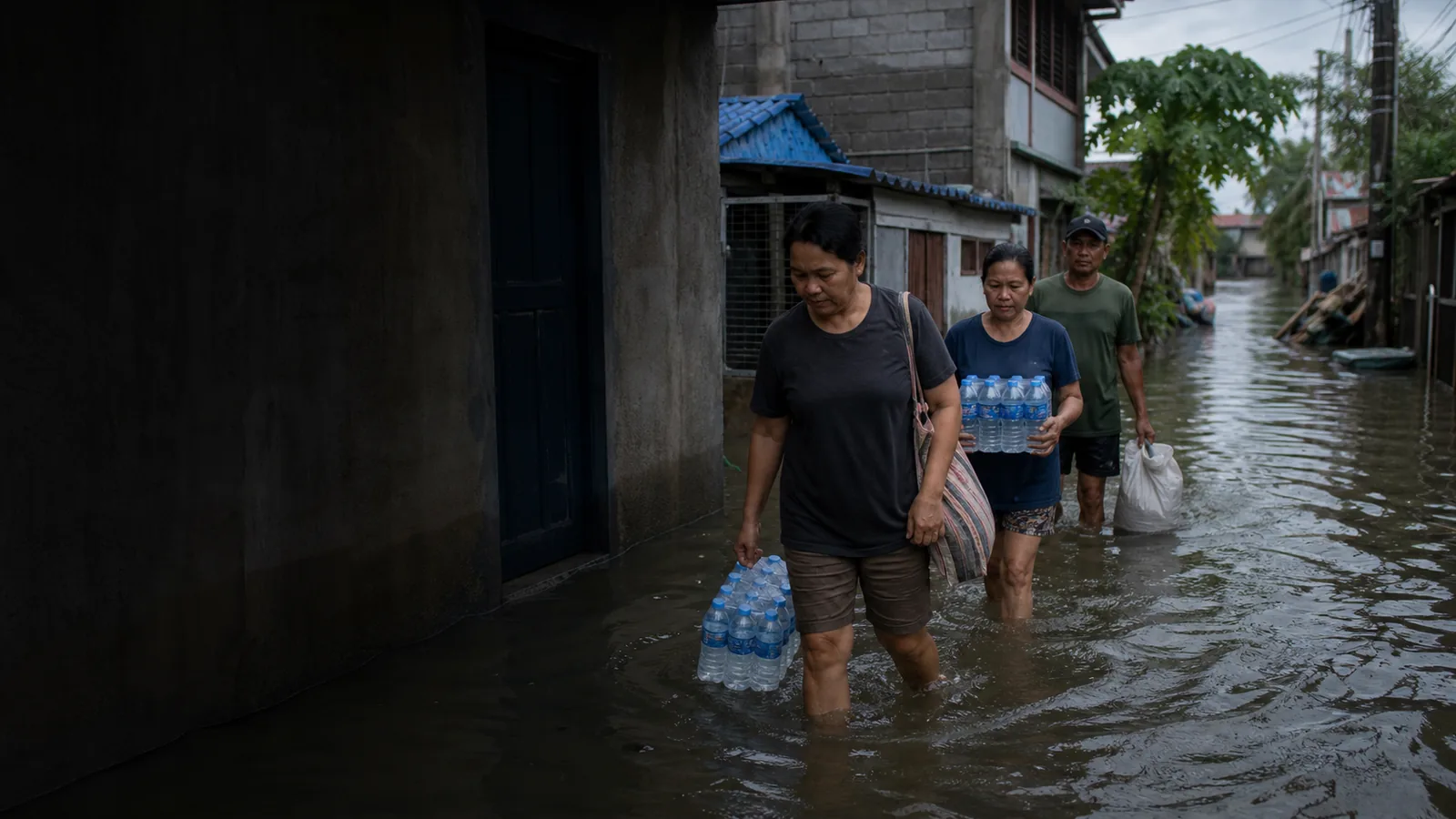
Philippines floods leave 197,822 displaced
Government reports record 9.09 million people affected, 197,822 still displaced and 3,728 homes damaged across the Philippines.
Flood response, evacuation support and damage assessment continue. Casualty and displacement figures remain provisional.
Latest timelineMore than 197,000 people remain displaced across the Philippines
The Philippines government reports that 9,086,667 people have been affected by the enhanced southwest monsoon and Tropical Cyclones Luis, Maymay and Neneng. The 31 August 6 PM balance covers 2,591,439 families in 6,175 barangays across Metro Manila and ten other regions.
At least 197,822 people remain displaced. Of these, 135,905 are staying in 1,255 evacuation centres and 61,917 are staying with relatives or friends. The 6 PM figure is lower than the 248,229 recorded that morning, but remains more than double the total reported when this article was first published on 12 August.
The Department of Social Welfare and Development records 3,728 damaged homes, including 458 destroyed and 3,270 partially damaged. National disaster reporting on 31 August listed 33 deaths, while assessments and local record checks were still continuing.
Government and local responders have reported more than PHP1.77 billion in humanitarian assistance. Operations include food and non-food distributions, camp coordination, protection support and monitoring of families both inside and outside formal evacuation centres.
PAGASA's latest outlook says the enhanced southwest monsoon is expected to continue bringing rain to parts of Luzon and the western Visayas. Further flooding and landslide risks could prolong displacement or interrupt returns where homes, roads, water systems and power supplies remain unsafe.
Large-scale displacement is continuing as fresh rain sustains flood risk
Conditions vary across the affected regions. Some families are returning, while others remain in crowded evacuation centres or host households because homes and essential services are still unsafe.
Shelter and protection
Evacuation sites need safe sleeping areas, lighting, privacy, accessible facilities and protection support. Families outside centres can be harder for responders to identify and assist.
Water, sanitation and health
Floodwater can contaminate wells and stored water. Clean water, hygiene supplies, drainage and surveillance for water-borne and mosquito-borne illness remain important.
Food and household essentials
Displaced households may need ready-to-eat food, cooking supplies, clothing, bedding, medicines and safe storage while markets and transport routes recover.
Access and livelihoods
Damaged roads, rough seas and local flooding can delay assistance. Lost work, damaged crops and household repairs can extend the impact after the immediate weather threat passes.
How the emergency developed
Affected population reaches 9.09 million
The 6 PM report records 197,822 people still displaced, 3,728 damaged homes and more than PHP1.77 billion in humanitarian assistance. National disaster reporting lists 33 deaths.
Monsoon rain renews flooding concerns
The southwest monsoon continues affecting Luzon and the Visayas. Government agencies expand distributions and local authorities maintain evacuation and protection support.
Initial report records 98,074 displaced
Authorities record 3.73 million people affected and 98,074 still displaced, including 53,570 people in evacuation centres.
Monsoon flooding continues
Flooding and strong winds affect Western Visayas and Metro Manila, while a tornado is reported in Iloilo.
Maymay makes landfall
Tropical Cyclone Maymay makes landfall near Magsingal in Ilocos Sur before weakening the following day.
Luis brings rain, floods and rough seas
Tropical Depression Luis develops on 1 August and weakens on 3 August after contributing to severe weather.
Flooding begins in Zamboanga City
The trough of a low-pressure area triggers heavy rain and flash flooding, marking the start of the consolidated event record.
Further rain, safe returns and public-health risks will shape the next phase
Official totals may change as local reports are validated and families move between evacuation centres, host households and their homes.
Rain and landslide risk
Further monsoon rain may trigger renewed flooding or slope failures in exposed areas, especially across parts of Luzon and the western Visayas.
Support beyond evacuation centres
People staying with relatives or in informal locations need to remain visible in registration and assistance planning.
Health monitoring
Water quality, sanitation, mosquito control and continuity of medicines require attention as floodwater recedes.
Household recovery
Repair materials, livelihood support and replacement of lost essentials will be important for families facing prolonged disruption.
Information used in this report
Department of Social Welfare and Development Disaster Response Operations Monitoring and Information Center; DOST-PAGASA; Office of Civil Defense and National Disaster Risk Reduction and Management Council; Philippine Information Agency; GMA News; and Philstar.
Publication and updates
- Published - Original report published.
- Updated - Material report update.